Nigeria Unveils New School Curriculum for 2025/2026: Fewer Subjects, Sharper Skills
Abuja, Nigeria – The Federal Government has officially launched a new school curriculum set to begin in the 2025/2026 academic session, marking one of the biggest educational reforms in decades.
At a national briefing, the Minister of Education, Dr. Maruf Tunji Alausa, alongside the Minister of State for Education, Prof. Suwaiba Sa’id Ahmad, explained that the reform is the product of extensive consultations with key education bodies including NERDC, WAEC, NECO, NBTE, and NABTEB.
The key message? “Lighter bags, sharper minds.”
Why Nigeria’s New Curriculum?
For years, pupils and parents complained about overloaded timetables that left children stressed and families struggling. The new curriculum aims to:
- Reduce subject overload.
- Focus on skills, technology, languages, and Nigerian history.
- Give teachers a simpler, more effective teaching structure.
- Prepare students for both higher education and real-world skills.
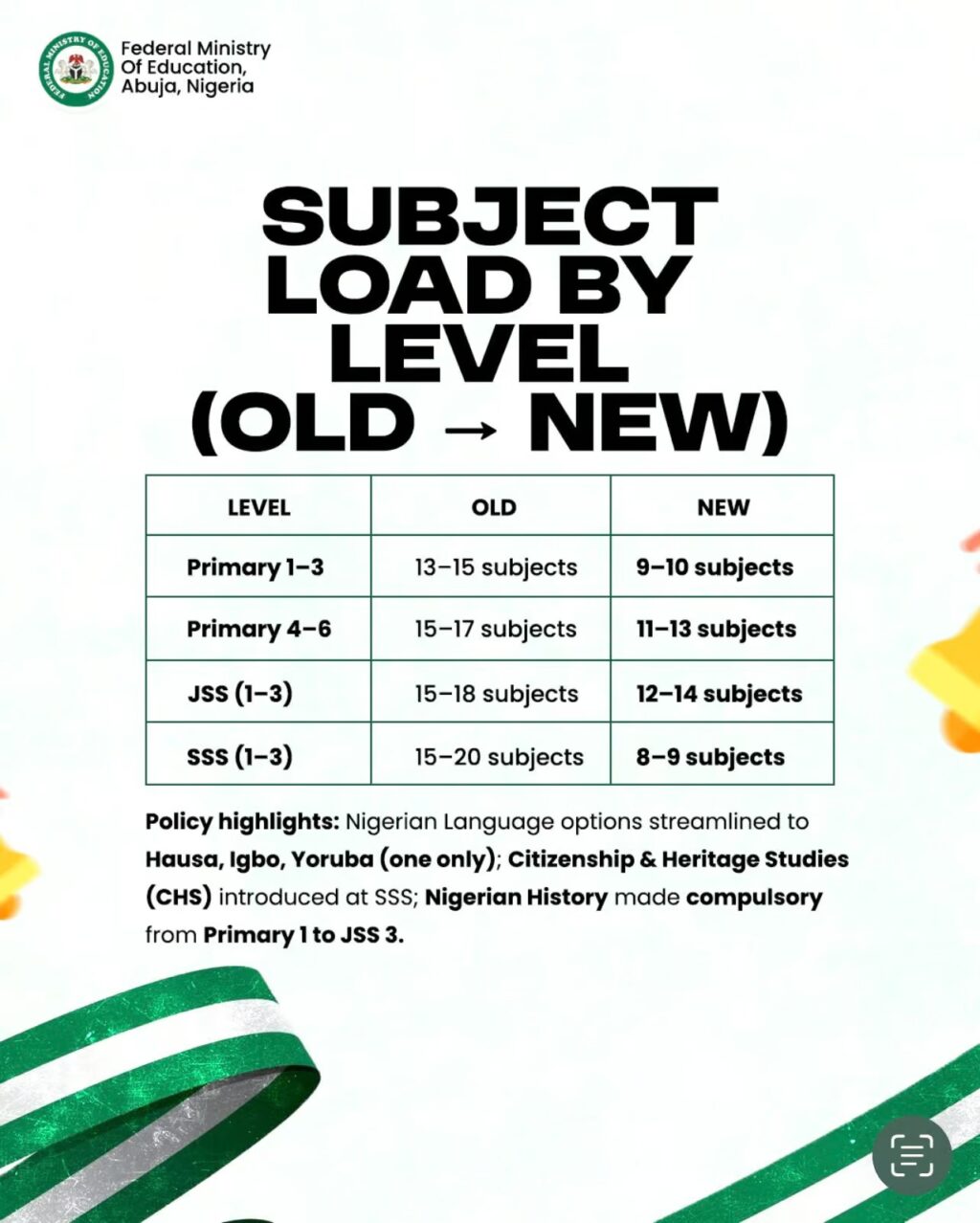
Subject Load by Level: Old vs. New
- Primary 1–3: Old 13–15 → New 9–10 subjects
- Primary 4–6: Old 15–17 → New 11–13 subjects
- JSS 1–3: Old 15–18 → New 12–14 subjects
- SSS 1–3: Old 15–20 → New 8–9 subjects
Fewer subjects, but more focus.
Key Policy Highlights
- One Nigerian Language Only – Hausa, Igbo, or Yoruba.
- Nigerian History is compulsory from Primary 1 to JSS 3.
- Citizenship & Heritage Studies (CHS) introduced at SSS, merging History, Civic Education, and Social Studies.
- Digital skills and trade subjects are compulsory across levels.
- Exam bodies (WAEC, NECO, NABTEB) will realign their exams to match the new curriculum.
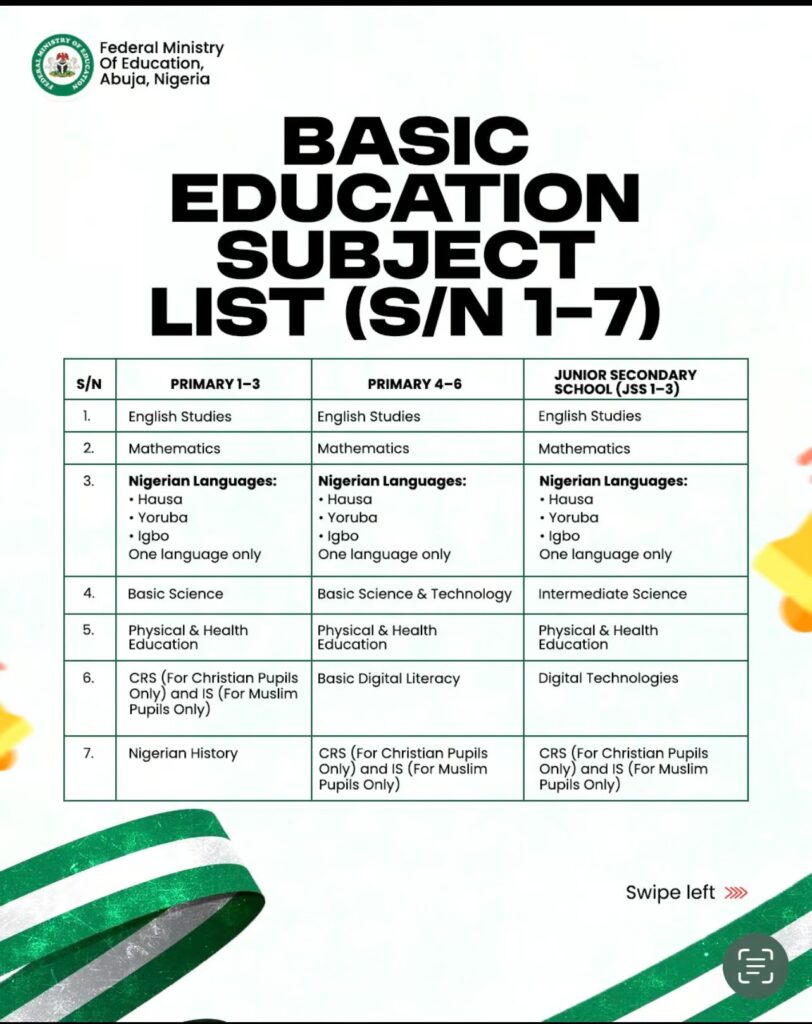
Basic Education (Primary & JSS) Subject Breakdown
Primary 1–3
- English Studies
- Mathematics
- One Nigerian Language (Hausa, Igbo, or Yoruba)
- Basic Science
- Physical & Health Education
- Nigerian History
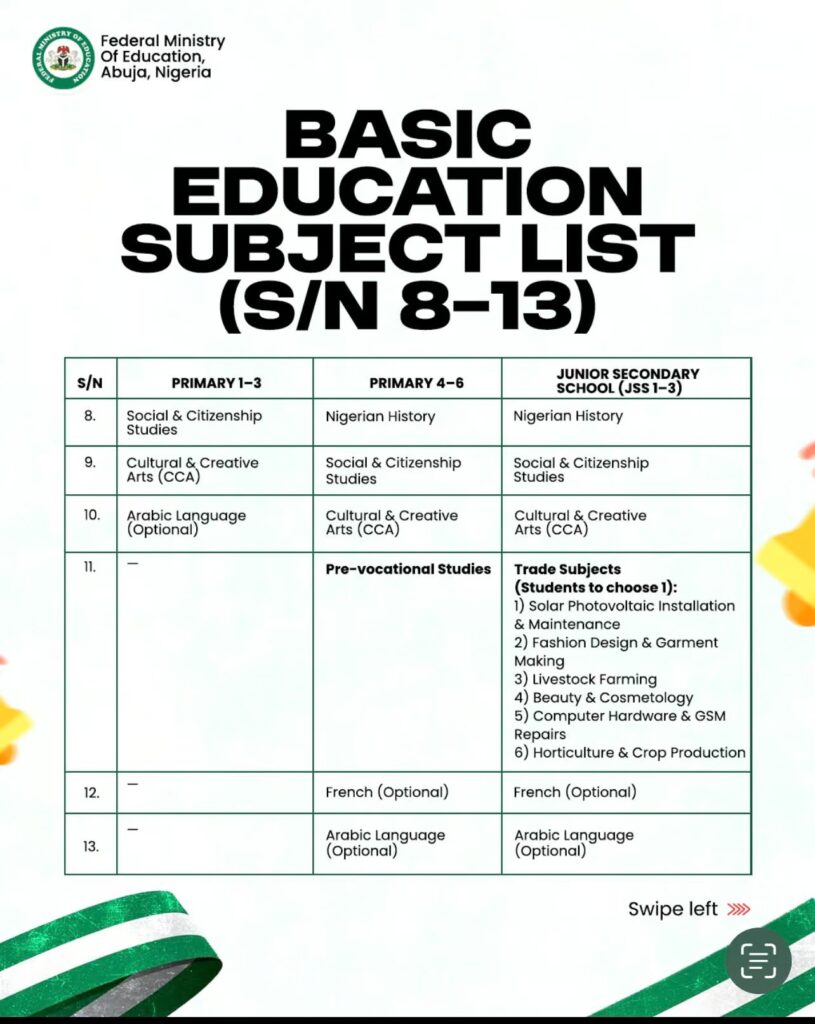
- Social & Citizenship Studies
- Cultural & Creative Arts
- CRS or Islamic Studies (based on faith)
- Arabic (optional)
Primary 4–6 (adds Digital Literacy, Pre-Vocational Studies, and optional French)
JSS 1–3 (adds Digital Technologies and Trade subjects such as: Solar Installation, Fashion Design, Livestock Farming, Beauty & Cosmetology, Computer Repairs, and Horticulture).
Senior Secondary School (SSS) Structure
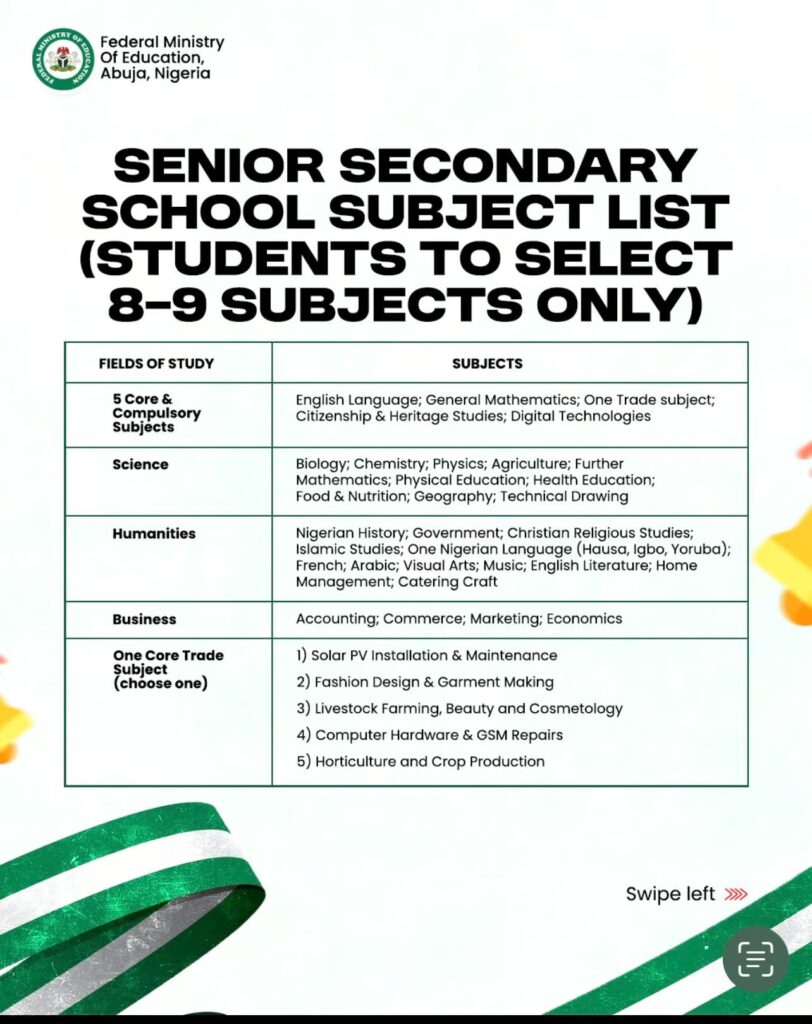
Students will now take 8–9 subjects only, including:
Core Compulsory Subjects (5):
- English Language
- General Mathematics
- Citizenship & Heritage Studies
- Digital Technologies
- One Trade Subject
Electives (choose from groups):
- Sciences: Biology, Chemistry, Physics, Agriculture, etc.
- Humanities: Nigerian History, Government, CRS/IRS, Languages, Literature, Arts.
- Business: Accounting, Commerce, Marketing, Economics.
Trade skills remain vital, ranging from Solar PV Installation to Fashion Design and Livestock Farming.
Why This Matters
- Students will face less academic pressure.
- Teachers get a clearer teaching guide.
- Nigeria builds a workforce with digital and vocational skills.
- Nigerian culture stays central, with History made compulsory.
The curriculum officially begins in the 2025/2026 school year. The Ministry has promised to guide schools, parents, and students to ensure a smooth transition.
You may also like to read: WAEC GCE 2025 Second Series: Full Guide on Registration, Subjects, Fees, and Deadlines