AI in Nigerian Exams 2026: WAEC Cheating & Assessment Reform
Artificial intelligence has entered Nigerian examination halls, and it’s redefining how students cheat. With 167,486 candidates facing result withholding in 2026, WAEC and West African schools face urgent pressure to reform assessment methods before technology outpaces policy. Discover what’s happening and what students must know.
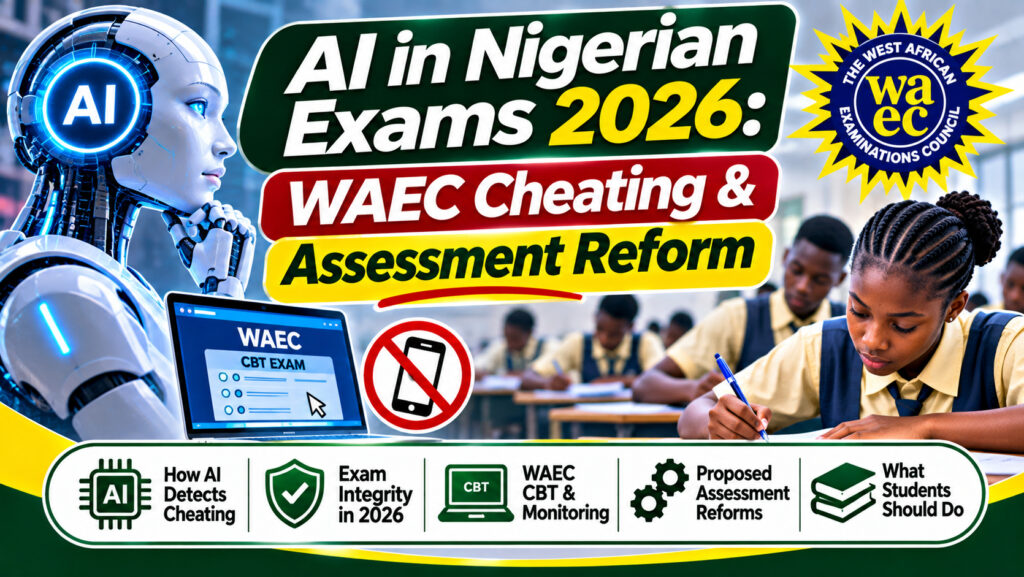
Artificial intelligence has officially entered the Nigerian examination hall, and it’s changing the game for cheating—fast. AI examination malpractice Nigeria 2026 is no longer just about hidden notes or mobile phones. According to recent reports from the examination integrity forum in Lagos, generative AI tools can now solve maths problems, write essays, summarise passages, and generate convincing explanations in seconds. Meanwhile, WAEC withheld results for over 167,000 Nigerian candidates in 2026 over examination malpractice, raising urgent questions about how West African schools can evolve assessment before technology outpaces policy.
The Scale of Examination Malpractice in Nigeria 2026
The numbers tell a sobering story. In the 2026 WASSCE examination series, WAEC withheld 167,486 candidate results—representing 8.59 percent of all test-takers—due to suspected examination malpractice. WAEC specifically identified mobile-phone use and organised cheating as persistent problems. Furthermore, Ghana’s results showed 7,434 subject cancellations and 861 entire-result cancellations related to unauthorised materials and phone possession.
These figures emerged before the full impact of generative AI tools became widespread. However, education stakeholders at the October 27, 2026 Lagos forum warned that AI can circumvent examination rules far more efficiently than traditional methods.
How AI Changes the Cheating Game
Unlike previous malpractice methods, artificial intelligence presents a fundamentally different challenge. A student no longer needs to memorise answers or rely on leaked questions. A smartphone running AI can:
- Interpret exam questions in real-time
- Generate complete essays instantly
- Solve mathematical and scientific problems
- Summarise passages accurately
- Produce seemingly credible explanations
The problem intensifies because technical surveillance alone cannot detect AI use effectively. A student typing into their phone calculator looks identical to one using ChatGPT or similar tools. This reality demands a rethink of how examinations actually assess student knowledge.
What Assessment Reform Looks Like in 2026
Participants at the Lagos education forum called for urgent action across three areas:
1. Stronger Teacher Preparation
Educators must understand both the capabilities and limitations of generative AI. Teachers cannot detect what they do not recognise. Therefore, professional development programmes must now include AI literacy.
2. Clearer Policies on AI Use
Schools need transparent guidelines distinguishing between acceptable and prohibited AI applications. Some institutions may permit students to use AI for learning but not during assessments. Others may redesign tasks to make AI outputs irrelevant.
3. Redesigned Assessment Methods
The most sustainable solution requires assessment that focuses on what students can do independently—not just what they can reproduce. This might include:
- Open-book examinations with source analysis tasks
- Oral examinations and presentations
- Project-based assessments evaluated over time
- Questions requiring original problem-solving, not template answers
Kano’s Education Success: A Different Story
While examination malpractice dominates headlines, Kano State offers a contrasting narrative. Independent media reported in November 2026 that Kano achieved its second consecutive year as Nigeria’s top-performing state in NECO results. This success was built on investment in thousands of new teachers, renovated classrooms, and improved teaching quality—fundamentals that matter more than surveillance systems.
This suggests that sustainable examination integrity depends less on catching cheaters and more on strengthening educational foundations.
Opportunities in Crisis: AI Scholarships and Skills
Interestingly, some Nigerian universities are embracing AI education proactively. Crescent University, Abeokuta announced AI scholarships for the first 50 applicants to its B.Sc. Artificial Intelligence programme in November 2026. This reflects broader recognition that students need formal education in AI, not just restrictions against misusing it.
For JAMB candidates and admission seekers, this signals that AI literacy will become increasingly valuable for university success and career readiness.
Frequently Asked Questions About AI and Nigerian Exams
How many Nigerian students had results withheld in 2026 due to examination malpractice?
WAEC withheld results for 167,486 Nigerian candidates in the 2026 WASSCE, representing 8.59% of all test-takers. This figure reflects both traditional malpractice methods (mobile phones, notes, organised cheating) and emerging concerns around AI tool misuse.
Can invigilators detect when students use AI during exams?
Not reliably. A student using a smartphone to run ChatGPT appears identical to one using a calculator. This is why experts emphasise that technical surveillance alone cannot protect academic integrity—assessment methods themselves must evolve to make AI shortcuts ineffective.
What is Crescent University’s AI scholarship programme?
Crescent University offered scholarships covering the B.Sc. Artificial Intelligence programme to the first 50 qualified applicants (applications closed 30 November 2026). Requirements included five SSCE credits (English, Maths, Physics) and an appropriate UTME score. This represents universities preparing students to work with AI responsibly, rather than just preventing its misuse.
What Students and Schools Should Do Now
The message is clear: examination integrity in Nigeria requires systemic reform, not just policing. For JAMB UTME candidates, this means understanding that:
- Using AI to complete your exam answers will result in result cancellation—the consequences are severe
- Universities increasingly value independent thinking and original problem-solving over test scores alone
- Learning AI skills through legitimate programmes (like Crescent’s scholarship) offers genuine competitive advantage
For schools and examination bodies, the path forward demands investment in teacher training, clearer AI policies, and assessment redesign—not just tighter surveillance.
Check the official JAMB portal for current examination guidelines, and share this article with peers preparing for 2026/2027 admissions to spread awareness of how the examination landscape is changing.